
For years, crypto compliance teams have mainly been asked to show that their policies exist.
In 2026, that standard is no longer enough.
The question is simple: can companies prove how a control worked, in a specific case, with specific data, at a specific point in time?
Regulators, banking partners, auditors, and internal risk committees all want more than broad statements about compliance readiness. They want operational proof. They want to see the alert, the data, the investigation path, the decision, the rationale, and the final record.
Evidence-based crypto compliance is becoming the new standard.
Three forces are driving this change at the same time. MiCA’s transitional period is ending across the EU. Stablecoins are moving deeper into financial stability discussions. Sanctions enforcement is becoming more network-driven, especially where crypto infrastructure is used to move funds across borders, entities, and counterparties.
The common thread is evidence.
Not screenshots. Not policy documents stored in a folder. Not a generic risk score with no explanation behind it.
Evidence-based compliance means having a clear, reviewable record of what happened, why it mattered, what the team did, and how the decision can be defended later.
This is the compliance standard crypto firms should prepare for now.
Evidence-Based Compliance Is Becoming The New Standard
Crypto compliance is moving from written controls to working controls.
A written policy still matters. However, it is no longer the full story. A compliance team also needs to show how the policy worked in practice.
For example, a sanctions policy may describe the escalation process. Evidence-based compliance requires the record behind the policy. That record should connect the alert, wallet exposure, counterparty context, analyst reasoning, escalation step, and outcome.
The same logic applies to transaction monitoring. A rule may exist, but the firm also needs to show when it triggered, what data supported it, and how the case was handled.
This creates a new burden for compliance leaders. They need systems that preserve evidence during daily operations, not after the fact. Otherwise, teams are forced to rebuild the story manually from exports, emails, screenshots, and analyst notes.
That model is slow, but more importantly, it is fragile.
The better model is evidence by design. Every important control should produce a record that is easy to review, export, and defend.
MiCA Turns Policy Into Proof
MiCA is often described as a licensing framework. That is true, but it understates the operational impact.
For crypto-asset service providers, authorization is not only about submitting documents. It also means being ready to show that controls work inside the business.
Supervisors will care about governance, client protection, outsourcing, risk controls, reporting, and the quality of operational records. Therefore, MiCA readiness is not only a legal project. It is an evidence project.
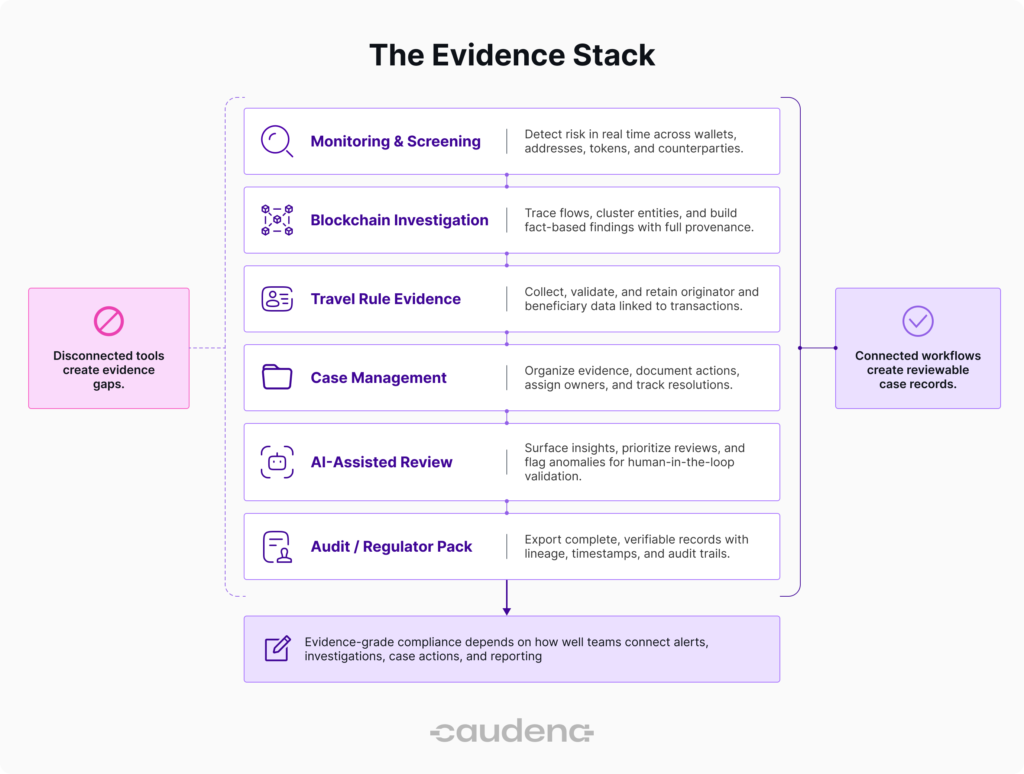
This matters because many compliance programs are still fragmented. Screening happens in one tool. Blockchain investigation happens in another. Travel Rule exceptions may sit in a separate workflow. Case notes often live somewhere else.
When a regulator, auditor, or banking partner asks for the full record, the team may need to reconstruct the case from different systems. That creates delay and risk.
Compliance teams should be able to produce a complete case record quickly. The record should show what happened, what data was used, who reviewed it, what decision was made, and why.
The practical lesson is clear: MiCA raises the value of audit-ready operational evidence.
The Travel Rule Exposes The Evidence Gap
The Travel Rule is often treated as a data transfer obligation.
It is much more than that in practice.
The Travel Rule creates a live operational record around relevant transfers. The firm needs to know what information accompanied the transfer, how complete it was, how the counterparty behaved, what decision was made, and how exceptions were handled.
The implementation is not as simple. Different counterparties use different systems. Jurisdictions apply rules with different timelines and expectations. Some transfers involve self-hosted wallets. Some counterparties respond late or provide incomplete data.
As a result, Travel Rule compliance can quickly become a fragmented evidence problem.
A strong Travel Rule workflow should not sit outside the main compliance case. It should connect with customer risk, wallet checks, blockchain analytics, sanctions screening, and case management.
The firm may have a Travel Rule process but not a defensible compliance story.
This matters because regulators are not only looking for data transmission. They are looking for effective controls, risk-based decisions, and traceable procedures.
For compliance teams, the priority is not only interoperability between vendors. It is interoperability between evidence.
Stablecoins Raise The Bar For Control Evidence
Stablecoins are no longer a narrow crypto product category.
They now sit inside wider discussions about payments, settlement, liquidity, reserves, redemption, and financial stability. Therefore, stablecoin oversight is becoming more operational and more evidence-driven.
A stablecoin program needs more than periodic statements. It needs a clear evidence layer around issuance, redemption, reserve composition, reconciliation, exceptions, and reporting.
The core issue is trust.
Stablecoin users need confidence that tokens are backed. Regulators need confidence that issuers can meet obligations. Banking partners need confidence that risks are monitored. Compliance leaders need confidence that reserve and transaction controls can be reviewed under pressure.
This does not mean every issuer needs to publish every internal control. However, internal records should be strong enough to support supervisory review, partner due diligence, and incident response.
For issuers, compliance and treasury operations are also starting to overlap. A reserve issue can become a compliance issue. A redemption issue can become a conduct issue. A sanctions exposure can become a market confidence issue.
In that environment, evidence quality matters.
Sanctions Risk Has Become A Network Problem
Sanctions compliance in crypto cannot stop at address screening.
Address screening remains necessary, but enforcement has moved beyond simple one-wallet exposure. Higher-risk cases now involve networks: successor entities, infrastructure providers, payment platforms, stablecoin routes, intermediaries, exchange clusters, and services designed to keep activity moving after enforcement action.
The Garantex and Grinex case shows this direction clearly. The Treasury did not describe a single exchange. It described a broader ecosystem involving a designated exchange, a successor platform, executives, partner companies, cybercrime facilitation, infrastructure disruption, customer migration, and a ruble-backed digital asset used in continued activity.
This changes the investigation standard for compliance teams.
A sanctions alert may be the start of a network review. The team may need to understand whether the exposure is direct or indirect. It may then also need to assess successor links, cross-chain movement, exchange infrastructure, and new tokens or services used to continue activity.
That cannot be handled effectively through a flat alert queue alone.
The team needs investigation tooling that can connect entities, transaction paths, wallet clusters, risk indicators, and decision history into one record.
The key question is not only whether the firm found a hit. It is whether the firm can explain the risk path.
Audit-Ready Investigations Need More Than A Graph
Blockchain analytics gives teams visibility.
Visibility is valuable, but it is not the same as evidence.
A graph can show movement of funds. A label can show attribution. A score can show risk. An audit-ready investigation needs to show the reasoning that connects those signals to the final decision.
The investigation record should make the case understandable to someone who was not present when the analyst worked on it. That could be a regulator, auditor, law enforcement partner, banking partner, board committee, or another analyst reviewing the case months later.
Strong investigation evidence should show the transaction path, relevant entities, confidence level, uncertainty, supporting data, and final conclusion.
It should also show what was not proven.
That last point matters. Good compliance evidence is not overconfident. It separates facts from indicators and indicators from assumptions.
This is one reason case management is becoming central to crypto compliance. The case is where alerts, blockchain evidence, Travel Rule records, analyst notes, decisions, approvals, and reports should come together.
Without that layer, teams are left with fragments.
Fragments are hard to defend.
AI Must Investigate, Not Guess
AI will become part of crypto compliance workflows.
The important question is how it connects to evidence.
In weak implementations, AI creates risk. It can produce confident summaries without enough sourcing. It can blur the line between fact and inference. It can generate narratives that sound complete but are hard to verify.
AI does something different in strong implementations.
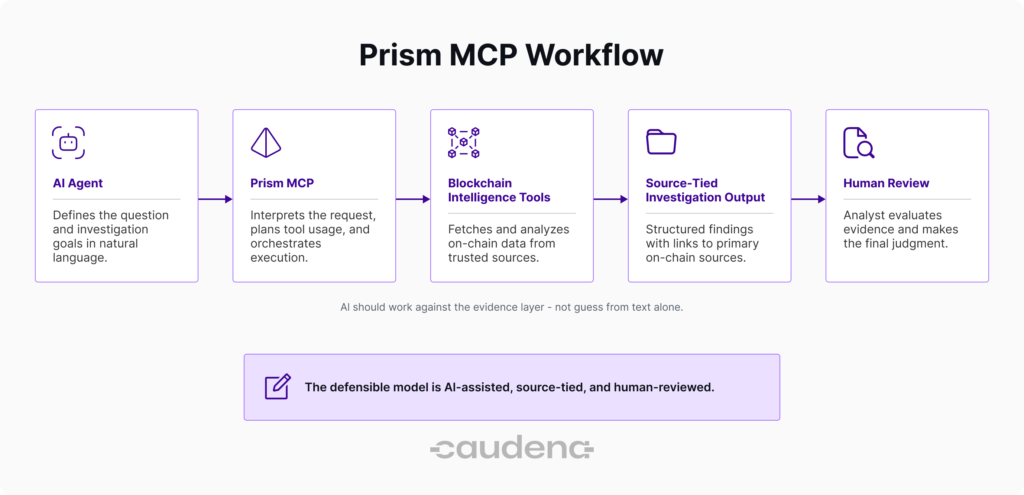
This is where Prism MCP matters. Prism MCP exposes blockchain intelligence as a machine-consumable forensic protocol. As a result, AI agents can query investigative tools instead of guessing from text alone.
The agent can retrieve address analytics, cluster intelligence, transaction history, risk context, and tracing results. Then it can return a structured narrative tied to transaction hashes and source data.
That makes the AI role much more defensible.
It is not a black-box decision maker. It is an investigation interface.
For compliance teams, this distinction is critical. AI should help analysts move faster. It should also make the case easier to review.
The final output should remain tied to the evidence used to produce it. The analyst should be able to verify, amend, reject, or approve the result.
The defensible model is AI-assisted, source-tied, and human-reviewed.
That is stronger than generic automation. It gives compliance teams the speed of AI without surrendering the discipline of investigation.
Evidence-Grade Compliance Infrastructure
The market does not need another disconnected alert feed.
Crypto compliance teams already have enough noise. What they need is infrastructure that connects monitoring, investigation, case management, reporting, and audit evidence.
That is the Caudena angle.
Prism supports blockchain investigation through graph-based analysis, entity scoring, filtering, fingerprinting, funds tracing, auto-demixing, cross-chain tracing, and AI reporting from the visual investigation canvas.
CRM connects real-time transaction monitoring, address analytics, rule-based risk triggers, case escalation, AI incident reporting, and built-in Prism investigations for triggered incidents.
Prism MCP extends this model into agentic workflows. It allows AI agents to interact with blockchain intelligence directly while keeping outputs tied to investigative data and human review.
When combined, Caudena delivers evidence-grade compliance infrastructure systems that help teams see, explain, document, and defend what happened.
That is a stronger position than screening.
Screening is one control. Evidence-grade infrastructure connects the control to the investigation, the case, the decision, and the audit trail.
Caudena’s current strategy supports this direction. Prism is the mature investigation board, CRM has monitoring and case-management foundations, and AI investigation agents are part of the near-term roadmap.
The New Standard: Show The Work
Crypto compliance is entering a more mature phase.
MiCA is pushing firms toward authorized, supervised, and operationally accountable models. The Travel Rule is forcing real-time data handling and exception records. Stablecoin oversight is turning reserve transparency into a control discipline. Sanctions enforcement is moving toward network-level investigation. AI is raising the need for explainable and reviewable workflows.
These changes point in one direction when taken together.
The firms that adapt fastest will not be the ones with the longest policy documents.
They will be the ones that can show their work.
Every alert, transfer review, sanctions escalation, reserve discrepancy, AI-assisted summary, and final case decision should connect to a defensible evidence trail.
That is the operating standard compliance leaders should build for now.
It is exactly where Caudena comes in.
Helping crypto teams move from fragmented controls to evidence-based decisions they can explain and defend.