
The hard part of a blockchain investigation is no longer finding transaction data.
The hard part is turning that data into a conclusion that can survive review.
That review may come from a prosecutor, a defense expert, a regulator, a partner agency, or another investigator who reopens the file months later. In each case, the same question appears:
How do you know?
A transaction graph can show movement. A label can suggest exposure. A heuristic can raise a lead. However, none of those elements is the same as evidence-ready case theory.
This is where modern crypto investigations often succeed or fail. The strongest investigators do not only trace funds. They explain what they observed, what they inferred, what they attributed, and what remains uncertain.
That standard matters more now because crypto crime workflows keep getting more complex. FATF’s 2025 virtual assets update highlights rising illicit use of stablecoins, asset recovery challenges, and the need for stronger international cooperation. FATF also notes that most on-chain illicit activity now involves stablecoins.
Blockchain Tracing Is Not Attribution
Many weak blockchain investigation reports make the same mistake. They move too quickly from transaction movement to attribution.
A defensible report separates three layers.
Observation is what the blockchain directly shows. This includes addresses, transaction hashes, timestamps, amounts, tokens, input-output structure, contract calls, bridge events, and service touchpoints.
Inference is what the observed pattern may suggest. For example, an investigator may identify a peel chain, consolidation, likely change output, mixer exposure, cross-chain movement, or service deposit pattern.
Attribution is the link to a real-world entity, service, wallet controller, suspect, or organization. This step often needs more than on-chain data. Investigators may need VASP records, subpoenas, seized devices, victim reports, infrastructure evidence, or corroborated OSINT.
In other words, tracing can support attribution. It does not replace it.
This is not just a writing preference. It is a risk-control practice. FATF’s red flag guidance says red flags should be considered in context. It also says the presence of one indicator does not necessarily show criminal activity. Instead, indicators should prompt monitoring, examination, and reporting where appropriate.
Strong Reports Show The Reasoning Trail
A good blockchain investigation should make sense to someone who did not run the graph.
That person should understand why the investigator followed one path, ignored another, escalated one lead, and marked another as unresolved.
Therefore, a serious case file should show the reasoning trail. It should answer practical questions:
What triggered the investigation?
What hypothesis did the investigator test?
Which transactions support the conclusion?
Which heuristic helped narrow the analysis?
Which alternative explanations did the investigator consider?
Where does confidence remain high?
Where does the case still need corroboration?
This may sound procedural. In practice, it protects the investigation.
A graph helps analysts see the flow. However, the report must explain the logic behind the flow. It should make the work reproducible, reviewable, and defensible.
That is the difference between “we traced it” and “we can explain how we reached this conclusion.”
Mixers Raise The Standard, Not The Volume
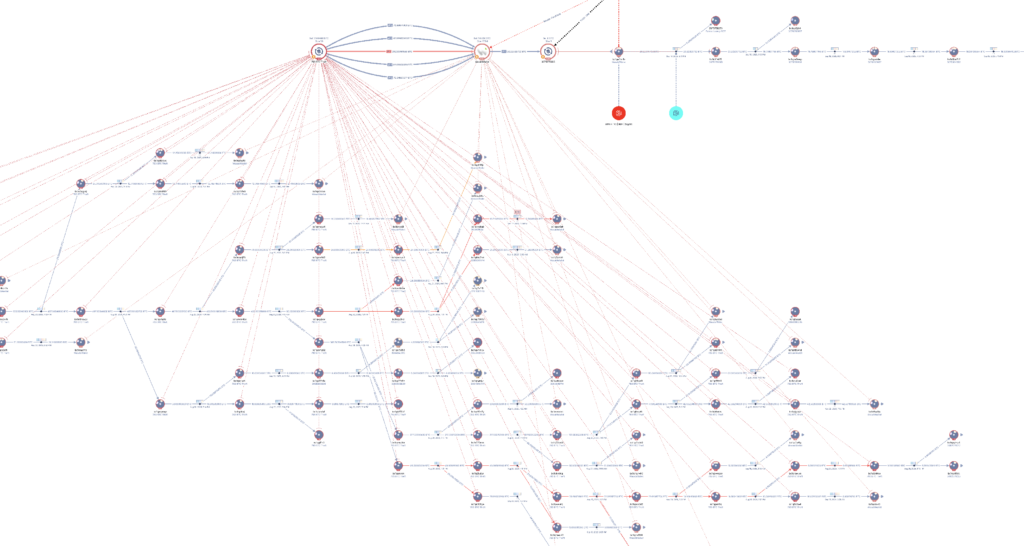
Crypto mixer investigations show why discipline matters.
Mixers, tumblers, CoinJoin workflows, and privacy tools can obscure transaction history. Criminals use them to break visibility, delay attribution, and complicate tracing. Still, mixer exposure does not automatically prove criminal control, laundering intent, or final attribution.
So the right question is not only:
Was a mixer used?
The better question is:
What can we still prove after the mixer, and what evidence do we need before making the next claim?
This distinction matters in real cases. In the ChipMixer takedown, the U.S. Department of Justice described a coordinated international action against a darknet cryptocurrency mixing service. DOJ said ChipMixer laundered more than $3 billion in cryptocurrency and connected the service to ransomware, darknet markets, fraud, crypto heists, and state-sponsored hacking activity. That public case narrative did not rely on a generic statement that mixing is suspicious. It connected transaction activity, infrastructure, criminal use, service behavior, and international enforcement action.
For investigators, the lesson is clear.
A mixer can create a strong investigative signal. It can justify deeper review. It can support an obfuscation hypothesis. However, a defensible report still needs timing, structure, source-of-funds context, destination analysis, service records, infrastructure links, or other corroboration.
Therefore, obfuscation does not end the case. It changes the evidentiary standard.
Cross-Chain Tracing Needs Clear Language
Cross-chain movement has become normal in crypto crime investigations.
Funds may move through bridges, DEXs, stablecoins, wrapped assets, swap services, and multiple networks before they reach a cash-out point. As a result, investigators no longer work with one clean transaction path. They often work with fragmented movement across chains and assets.
That creates two problems.
First, the investigator must connect events across different systems.
Second, the investigator must explain that connection in language another professional can verify.
“Funds moved cross-chain” is not enough.
A stronger report names the bridge, protocol, asset, transaction, contract interaction, or event that supports the link. It also states whether the connection is direct, probabilistic, or inferred from surrounding behavior.
This is where many reports become too vague. They describe the outcome but hide the reasoning. That makes the conclusion harder to defend.
Heuristics Should Narrow The Case, Not Finish It
Heuristics help investigators move faster.
They can identify likely change outputs, clustering patterns, peeling chains, consolidation behavior, transaction fingerprints, mixer exposure, and service interaction patterns. Without heuristics, many crypto investigations would move too slowly.
Still, heuristics need boundaries. A heuristic is a lead-strengthening tool. It is not a verdict.
For example, a transaction pattern may support a peel-chain hypothesis. However, the report should still explain why that pattern matters, what else could explain it, and what additional evidence would raise confidence.
The same principle applies to address clustering, service exposure, and transaction fingerprinting.
That is also why raw transaction structure still matters. If a team relies only on labels or summary dashboards, it may miss the mechanics that make a conclusion strong, weak, or premature.
Evidence-Ready Work Starts Before The Export
Many investigators treat reporting as the final step.
That creates avoidable problems.
If the investigator waits until the end to document the case, important reasoning may disappear. The team may lose why one branch mattered, why another branch stopped, or why the confidence level changed.
Instead, evidence-ready work should start before the export.
The investigator should capture the hypothesis, key decision points, filters used, transaction fingerprints, demixing logic, confidence levels, and unresolved questions while the work is still fresh. This does not mean every case needs a long memo. It means the report should preserve the logic that made the trace useful.
Good documentation helps teams hand off cases, brief prosecutors, support STR/SAR narratives, prepare partner-agency referrals, or return to a file when new intelligence appears.
In short, documentation is not paperwork after the investigation. It is part of the investigation.
AI Can Help, But The Investigator Must Stay In Control
AI can improve blockchain investigation workflows.
It can summarize long transaction paths, draft case narratives, reduce manual reporting work, and help investigators move faster from graph analysis to structured findings.
However, AI should not weaken the evidentiary standard.
A useful AI-assisted investigation must remain transparent. The investigator should be able to verify the data, inspect the reasoning, correct the output, and explain the final conclusion.
Speed without review creates risk.
That is especially true in law enforcement, FIU, regulator, and serious compliance contexts. These teams do not only need faster answers. They need answers they can defend.
Training Should Build Judgment, Not Tool Memory
Crypto investigation training often focuses on tool operation. That is useful, but it is not enough.
Real cases do not arrive as clean graphs. They involve partial visibility, wrong turns, privacy tools, service hops, cross-chain movement, conflicting indicators, and time pressure.
Therefore, advanced training should build judgment.
Investigators need to know when a trace is strong, when a heuristic is weak, when attribution needs corroboration, and when a report should say “consistent with” instead of “proves.”
The Proven Standard
What holds up under scrutiny is not the boldest claim. It is the clearest reasoning.
A defensible blockchain investigation shows what the chain directly reveals. Then it explains what the investigator inferred. After that, it states what attribution can support and what still needs external evidence.
This standard becomes even more important when a case involves mixers, cross-chain swaps, stablecoins, privacy tools, decentralized protocols, or service touchpoints across jurisdictions.
The goal is not to make every conclusion sound certain. The goal is to make every conclusion precise.
That is the skill advanced investigators need now. They must move beyond “we traced the funds” and toward a stronger standard:
Here is what we saw.
Here is what it means.
Here is why we believe it.
Here is what we cannot prove yet.
Here is the next action that follows.
That is what turns crypto tracing into blockchain investigation evidence.
And when someone asks, “How do you know?” — that is the work that holds up.
Caudena Academy’s Advanced Blockchain Investigations Course is built for public-sector investigators working complex crypto crime cases involving mixers, privacy technology, cross-chain movement, filtering, fingerprinting, demixing, and raw blockchain evidence.
Request the syllabus or agency briefing to see how the course helps teams move from on-chain traces to defensible case theory.